


Our dentists
Our founder, Dr. Erin Cho, and Dr. Ashley Choi, both trained at the University of Illinois Chicago.
Meet our team
When a tooth needs a dental crown instead of a filling, how a bridge fills a gap, and what each one involves.
A back tooth with a big old filling finally splits on a piece of crusty bread. A tooth that had a root canal years ago starts to feel fragile. Or there's a gap where a tooth was pulled, and the teeth beside it have started to lean in. Dental crowns and bridges are the usual repairs for all three, and we place both at our Lakeview practice.
A crown is a cap that covers the whole tooth above the gum, holding a weak tooth together so it can keep chewing. A bridge replaces a missing tooth with a false one, held in place by crowns on the teeth or implants on either side.
“Even if someone comes in for one tooth, I still zoom out. I want to understand why that tooth got there, looking at the bite, habits, gum health and the health of the whole mouth.”
When there isn't enough strong tooth left to hold a filling. A filling sits inside the tooth and relies on the walls around it. A crown wraps around the outside and holds the whole tooth together, so a bite can't wedge it apart.
The usual reasons are a crack, a large filling that has taken over most of the tooth, a back tooth after a root canal, or teeth worn down by grinding. The large filling is the one to watch: once it has replaced a lot of the tooth, that tooth becomes more prone to cracking over time.
A common worry is that a crown means the tooth is dead. It doesn't. Most crowned teeth still have a healthy nerve inside. Only a tooth whose nerve is infected or badly inflamed needs a root canal first.
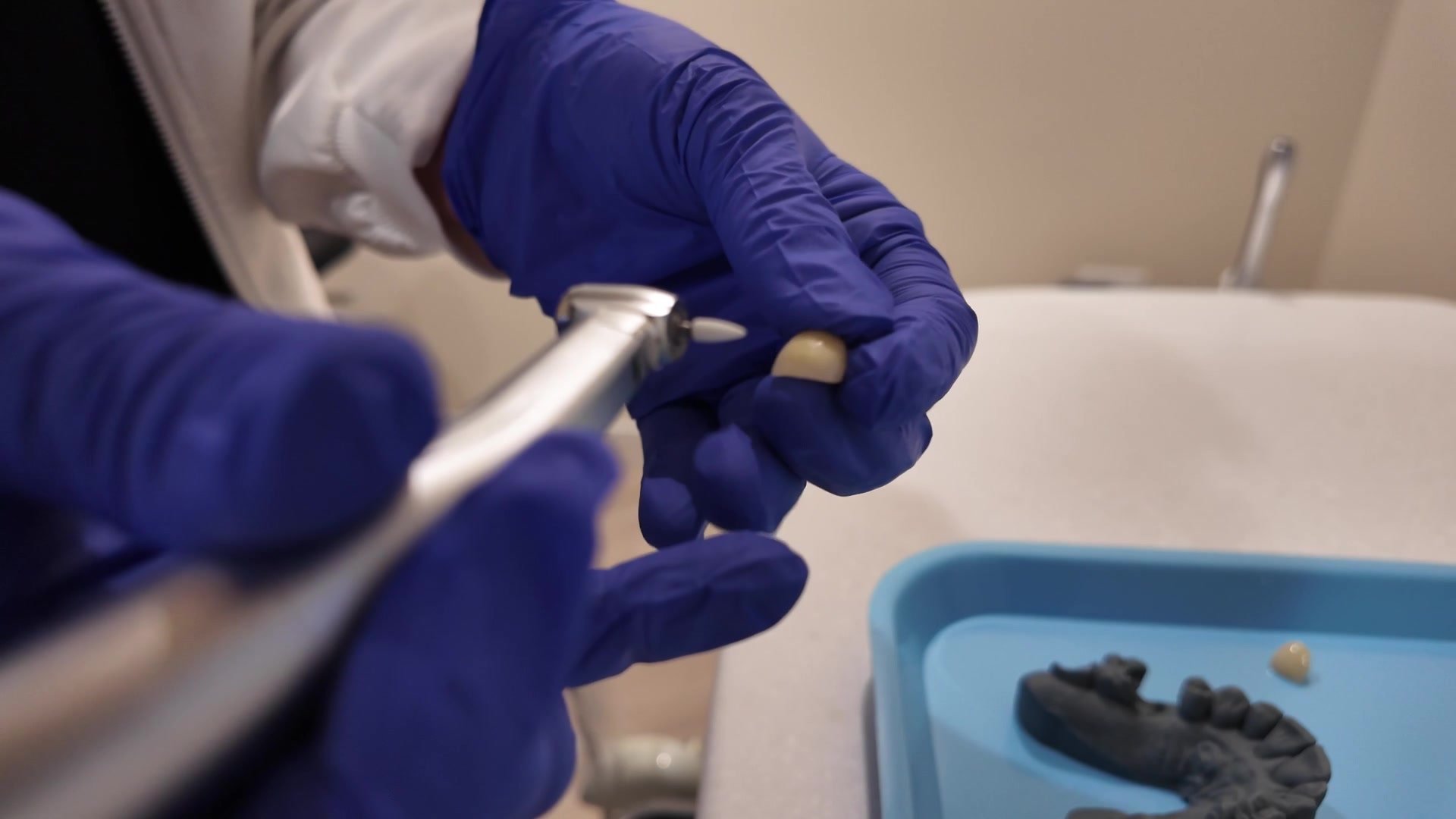
A crown usually takes two visits. At the first, the tooth is numbed, any decay is cleaned out and the tooth is shaped a little smaller, so the crown can fit over it without feeling bulky.
Then your teeth are scanned digitally to record the shape and your bite, so there's no tray of impression putty. You'll see the 3D scan on the screen, so you know exactly what your new crown is being shaped to fit. You leave with a temporary crown while the permanent one is made to match your other teeth.
At the second visit, the temporary comes off and the new crown is tried in, adjusted until your bite feels even, and bonded or cemented in place. Most crowns are porcelain or ceramic, chosen for strength and for how natural they'll look on that tooth.
Usually a broken tooth gets capped, and that's the end of it. But a crown lasts longer when it meets the opposite teeth evenly. Grinding, an uneven bite or gum disease can break or loosen a crown the same way they broke the tooth.
So before anything is made, we want to know why the tooth broke. We check your bite, the wear on your other teeth and your gums, even when you came in about one tooth. If grinding cracked it, we plan for the grinding too, so your new crown doesn't meet the same force that broke the tooth, and you aren't back in a few years with the same crack.
Dr. Erin trained at the Kois Center in restorative, gum and bite (occlusal) care, and that training shapes how she plans crowns and bridges.
A gap doesn't stay the same. The teeth beside it slowly drift and tip into the space, the tooth above or below can grow longer to meet nothing, and the bone where the root used to be shrinks. Chewing shifts onto the other teeth.
A traditional bridge is held by crowns on the teeth either side of the gap. It's fixed in place, so you never take it out, and it's usually done in a few weeks. The trade-off is that those neighboring teeth have to be shaped for crowns, even if they're healthy.
An implant replaces the root itself and stands on its own, so the teeth next to it are left alone. It takes longer, because the bone has to heal around it before the crown goes on. When several teeth are missing, implants can also hold a bridge.
Our founder, Dr. Erin Cho, and Dr. Ashley Choi, both trained at the University of Illinois Chicago.
Meet our team
3208 N Lincoln Ave, Lakeview. Open Tuesday to Friday, with street parking nearby.
About the studioSomething else on your mind? Call (312) 584-0707
Often 10 to 15 years or longer with good care. Grinding, decay at the edge of the crown and gum disease are the most common reasons one needs replacing.
Not usually. The tooth is numbed before it's shaped, so most people feel pressure rather than pain. The tooth and gum can be tender for a day or two afterward.
Call us so we can put it back. Until then, keep it safe, chew on the other side and avoid sticky food. Don't leave the tooth uncovered for long; it can shift or become sensitive.
A crown covers and protects one damaged tooth. A bridge replaces a missing tooth, using crowns on the teeth or implants beside the gap to hold the false tooth in place.
Brush twice a day and floss as usual, and use a floss threader or water flosser to clean under the false tooth. Food that collects there is the main cause of decay around a bridge.
Often, in part. Many plans cover some of the cost of crowns and bridges when they're needed to repair or replace teeth. We make using your dental benefits simple. Contact us and our team will be happy to help you understand what your plan may cover.


Book a visit. We'll look at the tooth, your bite and the teeth around it, and talk through every option before anything is done.